Winter or all-season tyres? What to choose and when in Latvia
When should you use winter or all-season tyres? Compare temperature guidance, seasonal use and the requirements for driving in Latvia.
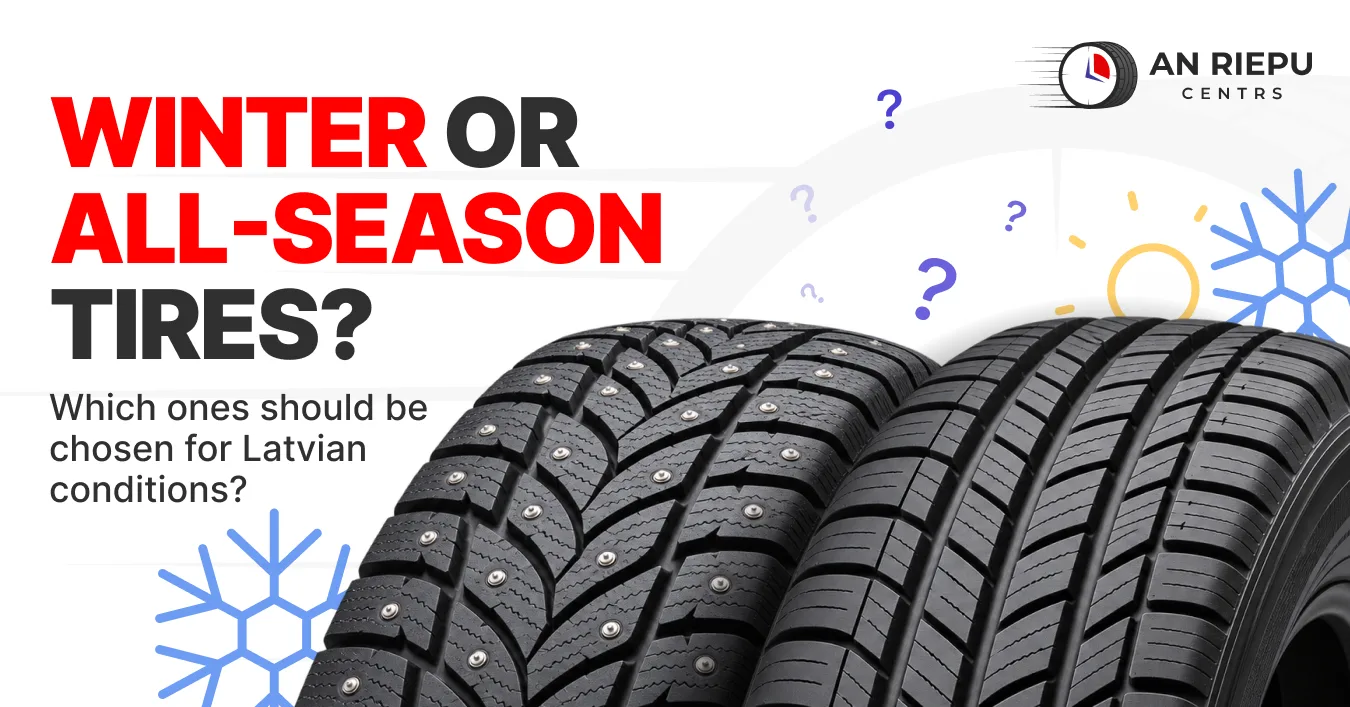
Winter tyres are designed for the colder months, while all-season tyres can be used throughout the year. Their capabilities differ, however, on snow, ice and in severe cold. When choosing tyres for Latvia, consider both the temperature and the roads you use every day.
If you need to drive through snowfall and on icy roads, suitable winter tyres are the better choice. If you mainly use cleared urban roads and can postpone journeys in difficult weather, quality all-season tyres carrying the 3PMSF marking are worth considering.
What temperatures are winter tyres designed for?
Plan your autumn tyre change when temperatures regularly fall below +7 °C. You do not need to wait for the first snow or for the temperature to reach minus 7 degrees. Winter tyres are also designed for cool weather above freezing.
Their rubber compounds contain rubber, silica and other ingredients in proportions tailored to cold conditions. This helps the tyre remain flexible and maintain grip at low temperatures.
The precise operating range depends on the model. For example, Michelin gives a temperature range of +7 °C to −20 °C for its Alpin winter tyres. Some Nordic winter tyres are designed for even colder conditions. These figures should not be applied to every winter tyre.
Winter tyres are not recommended for summer use, for example at +20 °C or +25 °C. They may wear faster, steering responses may feel less precise, and braking performance may deteriorate compared with tyres suited to the conditions.
What temperatures can all-season tyres handle?
All-season tyres combine summer and winter tyre characteristics so they can be used in both cool and warm weather. However, there is no universal range of −7 °C to +25 °C that applies to every model.
For example, Michelin’s guidance on 3PMSF-marked all-season tyres gives an approximate range of −10 °C to +30 °C. This is a manufacturer’s guide, not a guarantee of equal grip throughout that range or a rule for all all-season tyres.
During prolonged severe cold, particularly on snow and ice, suitable winter tyres will generally be the better choice. All-season tyres can remain in use during summer, but their braking, handling and wear should be assessed by model. It would be inaccurate to claim that every all-season tyre necessarily wears faster than a summer tyre in hot weather.
Which tyres should you use in autumn, winter, spring and summer?
In autumn, as temperatures regularly approach +7 °C and continue to fall, drivers using summer tyres should plan to switch to a winter set. Suitable all-season tyres do not need a seasonal change, but their condition and tread should be checked before winter.
In winter, road conditions determine the best choice. Winter tyres are more suitable for frequent frost, snowy roads and ice. In a milder winter, all-season tyres that meet the legal requirements can be used on well-maintained roads.
In spring, plan to switch from winter to summer tyres once temperatures stay consistently above +7 °C and frost or snow is no longer forecast. Treat +7 °C as a practical guide rather than a strict threshold: consider morning temperatures and the weather forecast as well.
In summer, use summer or all-season tyres. Save your winter set for the next cold season.
How do the tread and sipes differ?
Winter tyres usually have a dense network of sipes. These are small cuts in the tread blocks whose edges help generate grip on snow and ice. Wider grooves channel away water and slush.
According to Continental, new winter tyres often have a tread depth of approximately 8 to 9.5 mm. The exact depth depends on the model and size. A range of 9 to 17 mm should not be presented as standard for winter tyres on passenger cars.
All-season tread designs combine features for dry tarmac, rain and snow. These tyres also have sipes, but their number and arrangement vary. The tread is not necessarily divided into separate “summer” and “winter” sections, and 7 to 9 mm is not a universal depth for every model either.
It is the combination that matters: the rubber compound, tread pattern, remaining tread depth and condition of the tyre.
How do they perform on snow, ice and wet roads?
Winter tyres are designed to provide grip in cold weather, but the model still needs to suit the conditions. European winter tyres are more focused on variable winter weather, wet tarmac and snow. Nordic winter tyres are more specifically adapted to severe cold, compacted snow and ice.
All-season tyres are designed for changing weather and can perform well on snow. They are not automatically “helpless” in winter, but their capabilities on ice and in difficult snow conditions are generally more limited than those of suitable winter tyres.
Even winter tyres cannot guarantee that a car will get through any snowdrift or never slide on ice. Adjust your speed and following distance to the road conditions.
Which markings are required in Latvia?
The three-peak mountain snowflake symbol, or 3PMSF, can appear on both winter and all-season tyres. It confirms that a tyre has met specified grip requirements in a snow test, but does not guarantee identical performance on ice.
The names All Season, All Weather and 4S indicate use across different seasons. M+S stands for “mud and snow”, but this marking alone does not meet Latvia’s winter tyre requirements.
From 1 December to 1 March, cars and vans with a maximum authorised mass of up to 3.5 tonnes must use tyres that meet the winter requirements, carry the 3PMSF marking and have at least 4 mm of tread. This also applies to all-season tyres.
If you choose studded winter tyres, they are permitted in Latvia from 1 October to 30 April.
What is the best choice for driving in Latvia?
If you drive every day, regularly travel outside towns and cannot postpone journeys because of bad weather, separate winter and summer sets are recommended. This allows you to choose tyres for the conditions in each season.
All-season tyres can be a practical option for lower annual mileage, moderate weather and regularly cleared roads. Before buying, check the 3PMSF marking and the characteristics of the particular model.
At AN Riepu Centrs, we will help you choose tyres to suit your vehicle, routes and driving habits. If you already have a set, we can check the tread, markings and condition to establish whether it is suitable for the coming season.