When should you fit winter tyres in Latvia? Don’t wait for snow
Find out when winter tyres are compulsory in Latvia, which markings you need and the minimum tread depths for cars, lorries and buses.
Your car must be fitted with winter tyres by 1 December. But if mornings are getting colder and temperatures regularly fall to +7 °C or below, it is worth booking your tyre change sooner. The first icy morning can arrive well before December.
Before fitting winter tyres to a car, check two things: the sidewall must carry the mountain and snowflake symbol, and the tread must be at least 4 mm deep. An M+S marking alone is not enough for Latvia’s compulsory winter tyre period. Different rules apply to vehicles over 3.5 tonnes, as explained below.
When are winter tyres compulsory?
In Latvia, winter tyres are compulsory from 1 December to 1 March for motor vehicles, including buses, with a maximum authorised mass of no more than 3.5 tonnes.
The requirement applies throughout this period, even in mild weather with no snow. Plan your tyre change in advance so your vehicle is ready by the beginning of December.
Should you wait for temperatures to fall below freezing?
No. Start thinking about changing your tyres when temperatures regularly approach +7 °C and continue to fall. Winter tyres are designed for cold weather, not just snow-covered roads.
Treat +7 °C as a useful guide when deciding when to change your tyres. Think about when and where you drive, too. If you leave for work early in the morning, the temperature at that time matters more than the warmth of a sunny afternoon.
How do you know if your tyres meet the winter requirements?
Check the sidewall for the three-peak mountain snowflake symbol, also known as the 3PMSF marking.
Tyres marked only M+S cannot be used on vehicles with a maximum authorised mass of up to 3.5 tonnes during Latvia’s compulsory winter tyre period. This also applies to all-season tyres. The description “all-season” alone does not mean a tyre meets the rules: check its markings and condition.
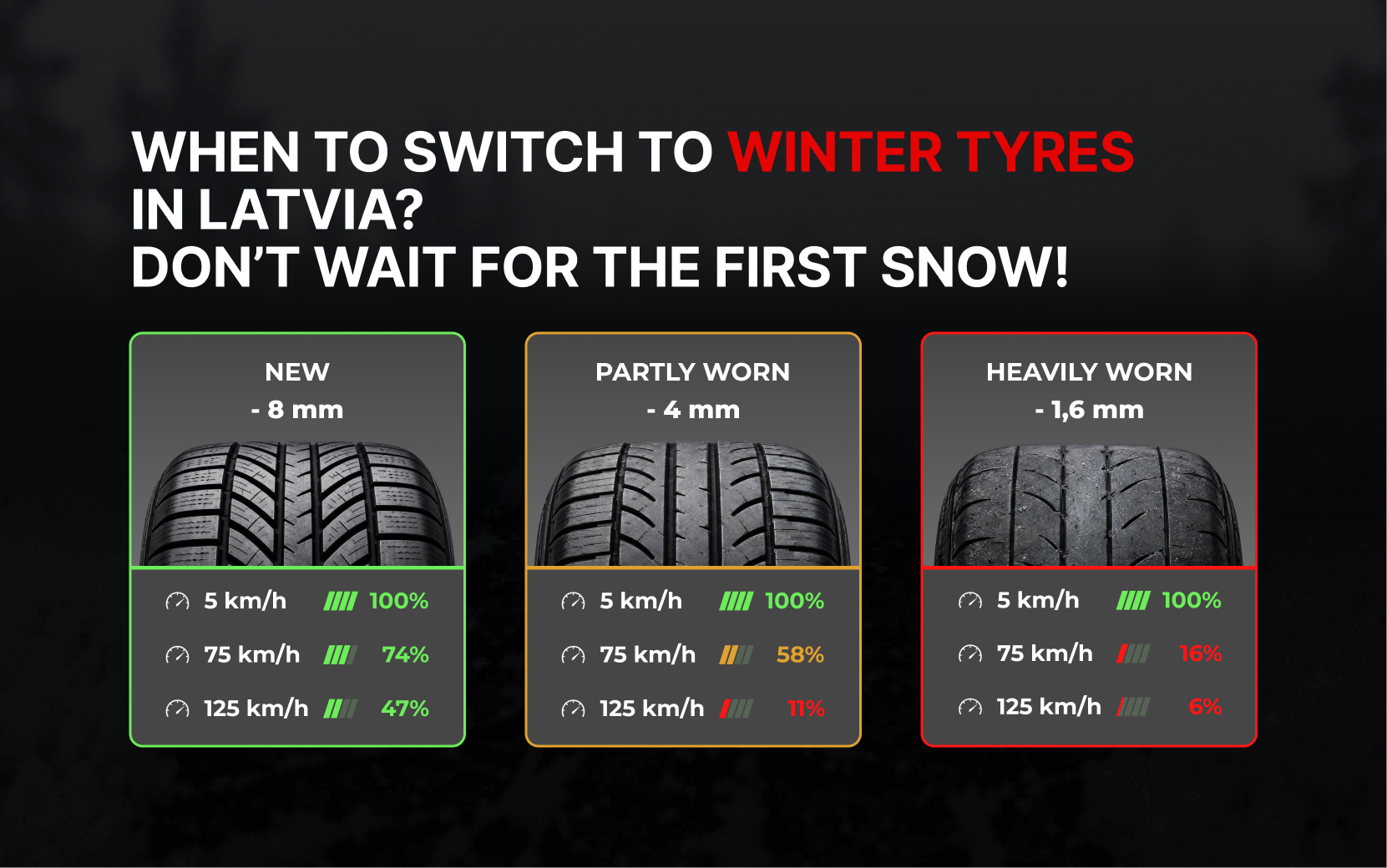
Winter tyre tread depth: at least 4 mm
During the compulsory winter tyre period, winter tyres on vehicles with a maximum authorised mass of up to 3.5 tonnes must have a tread depth of at least 4 mm.
This is the legal minimum. If your tyres are already close to that limit in autumn, do not assume they will last all winter. The tread will continue to wear as you drive.
Check the overall condition of the tyres as well. Cracks, damage or uneven wear are reasons to have them inspected by a specialist, even if the tread is still deep enough.
What are the rules for vehicles over 3.5 tonnes?
Latvia has different requirements for lorries and buses with a maximum authorised mass above 3.5 tonnes. From 1 December to 1 March, the minimum tyre tread depth is 2 mm for lorries and 3 mm for buses.
These vehicles are not subject to the same requirement to fit winter tyres carrying the mountain and snowflake symbol as vehicles up to 3.5 tonnes. However, tyres should be chosen to suit the road conditions, vehicle load and manufacturer’s guidance. Meeting the minimum tread depth alone does not mean a tyre is suitable for snow or ice.
Use the maximum authorised mass shown on the vehicle’s registration certificate. The same weight-based rules apply even when a lorry is travelling without a load.
For international journeys, check the requirements in every country on your route before setting off. They may differ from the rules in Latvia.
When can you use studded tyres?
In Latvia, studded tyres are permitted from 1 October to 30 April. From 1 May, they must not be used on public roads until the next permitted season begins.
This restriction applies specifically to studded tyres. Non-studded winter tyres can be fitted before 1 October if the weather calls for them.
Are your tyres ready for winter?
If you are unsure, visit AN Riepu Centrs. Our technicians will check the tread depth, markings and condition of your tyres and explain whether they are still suitable for winter driving.
If you need a new set, we will help you choose tyres that suit your vehicle and your everyday journeys.
Have your tyres checked in good time, so their condition is one less thing to worry about on the first icy morning.